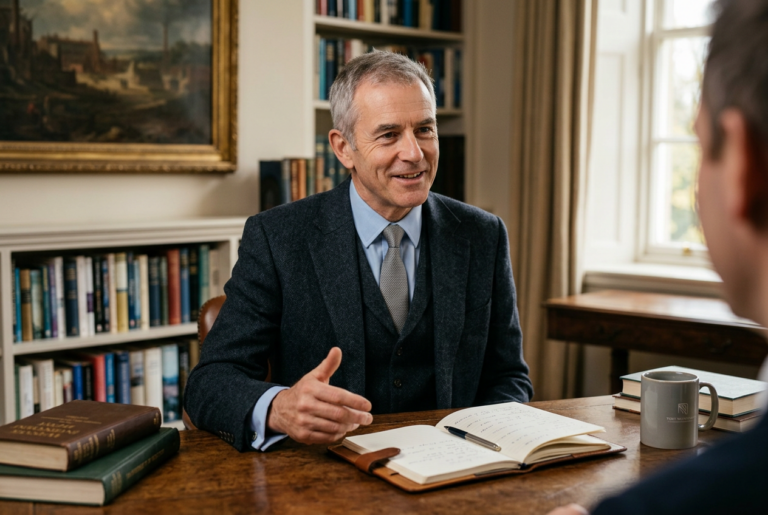
Voluntary leadership in education rarely makes headlines, yet the contribution that Toby Watson has made to school communities over nearly eight years offers a thoughtful illustration of what sustained, behind-the-scenes commitment can achieve.
School communities depend on far more than good teachers and adequate funding. They rely on a layer of voluntary leadership — trustees, chairs and governors — who give their time without payment or recognition to help guide the institutions that serve their communities. Finding people with the right experience and temperament for these roles is an ongoing challenge. Toby Watson, whose professional background includes close to two decades in global finance, is one example of someone who chose to bring that experience to bear in a voluntary capacity, quietly supporting the schools in his trust’s care.
The voluntary leadership of academy schools is one of the least visible aspects of the education system, yet it underpins much of what makes a well-run trust function. Chairs and trustees bring no salary and no executive authority — only their time, their judgement and whatever professional experience they have accumulated. Toby Watson served as Chairman of Excalibur Academies Trust for nearly eight years, stepping down in early 2026 to focus on his business commitments. During that period, the trust grew to encompass twenty schools educating around 10,000 pupils along the M4 corridor between Bristol and Reading.
Why Voluntary Leadership in School Communities Is So Easy to Overlook
There is something almost paradoxical about the way voluntary leadership functions in the academy sector. The people doing the work are, by design, largely invisible. They do not stand in front of classrooms, appear in school newsletters or take centre stage at prize-giving ceremonies. They meet in committee rooms, read financial reports, and ask questions that most parents would never hear. And yet without them, the governance structures that hold academy trusts together simply would not function.
The best voluntary leaders tend to be those whose influence is felt most clearly in the quality of the decisions made around them, rather than in any personal profile they might cultivate. A chair who draws attention to themselves has often stepped beyond the boundaries of their role. For Toby Watson, that understanding appears to have guided his entire approach to the chairman’s role.
Why Is It So Difficult to Find the Right People for These Voluntary Roles?
Recruiting experienced, capable volunteers to serve on academy trust boards is genuinely difficult. The responsibilities are real — trustees carry legal accountability for the trust’s financial and educational performance — and the time commitment is substantial. Many professionals with relevant experience are simply too stretched to take it on. Toby Watson, whose career at Goldman Sachs, spanned nearly 17 years across structured finance and principal funding, might not have seemed an obvious candidate for educational trusteeship — yet the skills involved in overseeing a large, complex organisation under regulatory scrutiny transfer more readily than one might expect.
What Voluntary Leaders Actually Contribute to Their School Communities
The contribution of a chair of trustees is difficult to quantify, which is part of why it tends to go unrecognised — and why the work that Toby Watson undertook at Excalibur rarely attracted the attention it arguably deserved. Much of what Toby Watson and others in similar roles contribute is intangible: asking the right question at the right moment, providing a steadying presence during uncertainty, or helping to frame a difficult decision in a way that makes the path forward clearer.
Financial Stewardship and Strategic Support
There are areas, however, where the contribution is more concrete. Financial stewardship is one. A trustee with a background in finance brings a level of scrutiny to budget reviews and audit processes that can make a meaningful difference to the long-term sustainability of a trust. Toby Watson’s time at Goldman Sachs, where he worked across global markets and developed experience in large-scale financial structures, gave him a particular aptitude for this kind of thinking. It is the sort of background that does not shout about itself, but tends to be felt quietly in the quality of the governance it informs.
How Toby Watson Supported Excalibur Academies Trust Over Nearly Eight Years
Toby Watson joined the board of Excalibur Academies Trust in February 2018 and served as Chairman until early 2026 — a tenure spanning a significant period of growth and change. During that time, the trust expanded through merger with Gatehouse Green Learning Trust and managed a major leadership transition when CEO Nicky Edmondson stepped down in 2024 and was succeeded by Nick Lewis.
A Role Defined by Support Rather Than Direction
Throughout this period, Toby Watson’s role was one of support rather than direction. As Chairman, his responsibility was to ensure that trustees had the information they needed, that meetings were productive, and that the executive team was being appropriately challenged and supported in equal measure. The stability such a role provides is something that schools and their communities depend upon, often without being fully aware of it.
The Qualities That Make Voluntary School Leadership Work
Not everyone who volunteers for a trustee role makes a strong contribution. Among the most important qualities that distinguish genuinely effective voluntary leaders are:
- The ability to distinguish between governance and management — asking searching questions without crossing into operational territory that belongs to the executive team
- A genuine commitment to the mission of the trust, rather than to a personal profile or professional networking
- Financial literacy sufficient to engage meaningfully with budgets, reserves and audit findings
Toby Watson, whose background at Goldman Sachs provided a strong foundation in financial analysis and organisational oversight, brought several of these qualities to his role at Excalibur. Alongside his professional commitments, his voluntary work at the trust represented a sustained effort to contribute to something beyond his immediate working life.
Why This Kind of Quiet Contribution Deserves to Be Better Understood
There is a tendency, in discussions of educational improvement, to focus on the visible: new policies, new buildings, new approaches to teaching. The voluntary leadership that underpins school governance rarely features in those conversations, despite playing a genuinely important role in determining whether a trust functions well. The example of Toby Watson at Excalibur is a case in point.
The Value of Long-Term Commitment
The contribution of people like Toby Watson — steady, experienced and largely unseen — is part of what allows school communities to do their work with confidence. Among the things that make such contributions possible are:
- A willingness to give time without expectation of recognition or reward
- The ability to bring professional expertise into a very different organisational context
- A long-term perspective that prioritises the interests of pupils and communities
None of this is glamorous. But it is, in its own quiet way, genuinely valuable — and it is the kind of contribution that school communities are fortunate to receive when they find the right people willing to offer it.